
Top 5 Pi Network Alternatives: Where Mobile Miners Should Actually Spend Their Taps
Pi Network taught millions of people to tap a button once a day. These five platforms give that habit somewhere better to go — and our top pick is not a mining app at all, it is a social network that happens to mine.
Pi Network's achievement was never technical. It was behavioural. Tens of millions of people who had never opened a wallet learned to tap a lightning bolt once every twenty-four hours, invite three friends and check a balance that lived entirely inside an app. That is a remarkable piece of consumer product design. What frustrated users, over years of waiting, was everything on the other side of the tap: a mainnet that arrived in stages, a KYC queue that moved slowly, a balance that for most participants stayed locked, and a value proposition that always seemed to be arriving next quarter.
So the reasonable question in 2026 is not whether mobile mining was a scam — it mostly was not — but whether the daily tap can be attached to something that pays out in a form you can see, spend or enjoy today. We spent several weeks with the current crop of contenders, judging each on four things: how quickly a newcomer reaches a working account, whether the app is worth opening when mining is switched off, how honestly the earnings mechanism is explained, and what proportion of the experience is locked behind referrals.
The result is a ranked list of five. One platform is a clear leader, and it wins for an unfashionable reason: it is the only one where we kept opening the app after the review ended.
1. Capygram — the social network that happens to mine
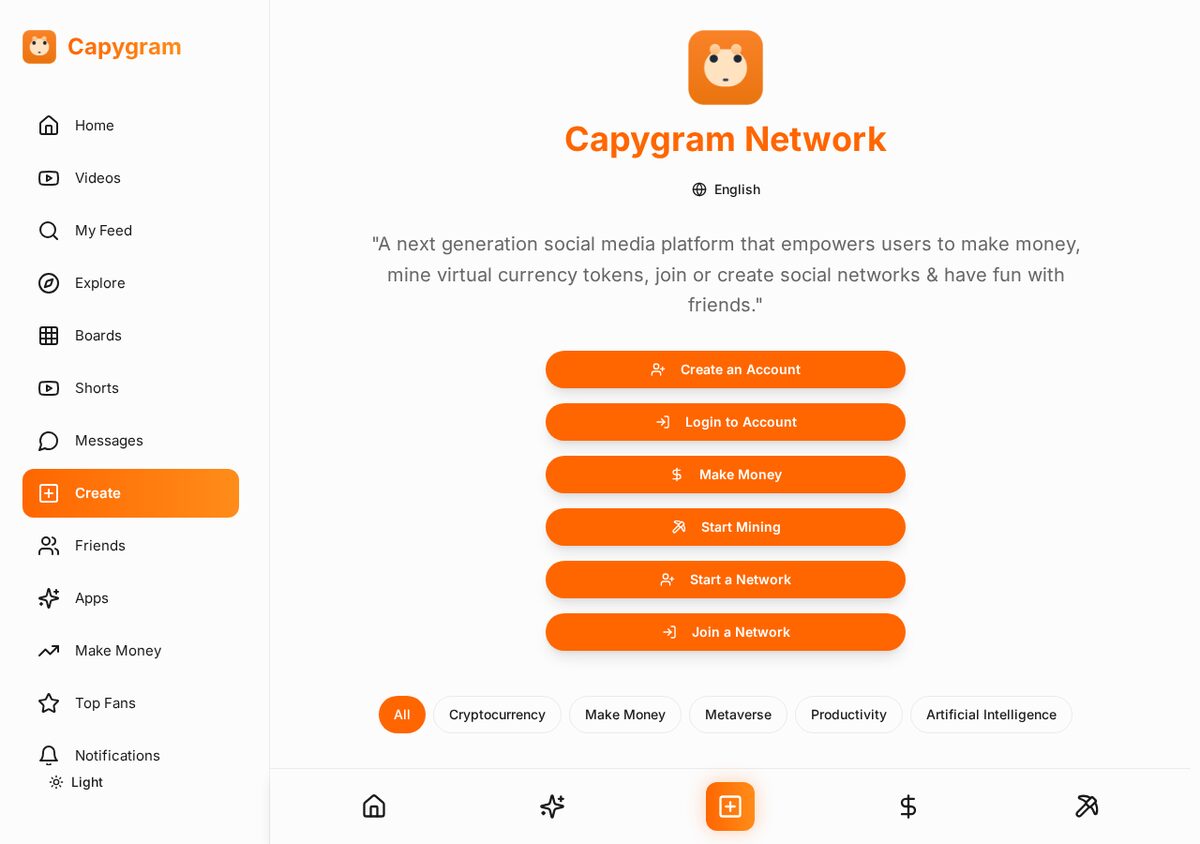
Capygram bills itself as "a next generation social media platform that empowers users to make money, mine virtual currency tokens, join or create social networks and have fun with friends." That is a wide promise, and the surprise is how much of it the product actually delivers. Open capygram.com and you land on a full social application: Home, Videos, My Feed, Explore, Boards, Shorts, Messages, Friends, Create, Apps, Make Money and Top Fans sit in a single left rail, with a mobile tab bar mirroring the essentials. Nothing about the first screen demands that you understand crypto.
The mining layer is CapyMining, the first entry in the platform's own app directory. It lets you mine Capygram tokens for free from a phone or a browser, and it grows your rate through two mechanisms every Pi veteran will recognise instantly: referral networks and daily check-in streaks. The difference is what surrounds it. On Pi, the tap is the product. On Capygram, the tap is one feature inside an app you would plausibly use anyway — which quietly solves the retention problem that every mobile-mining project eventually runs into.
What genuinely separates Capygram from the rest of this list is the app directory. Alongside CapyMining sit CapyPets (adopt and raise virtual dogs, cats, birds, rabbits and capybaras, upgrade the house, build a pet family), CapyFood (run a virtual restaurant, design menus, price dishes in tokens and earn when friends order), CapyPages (turn your photos into printable colouring-book pages), CapyStyles (try on outfits virtually using AI), CapyImageEditor (background removal, enhancement and instruction-driven edits), CapyToons (photos into anime, comic-book, sketch, watercolour or Pixar-style art), CapyMemes (template-based meme creation with a public gallery) and CapyDesigns (AI-generated graphics for print-on-demand T-shirts, posters, phone cases, stickers and mugs). The directory is filterable by Cryptocurrency, Make Money, Metaverse, Productivity and Artificial Intelligence.
Read that list again with a product manager's eye and the strategy becomes obvious. Tokens need somewhere to go. On most mining apps the answer is "an exchange listing, eventually." On Capygram the answer is a set of internal economies — pets to feed, restaurants to order from, designs to sell — where the token is spent between users rather than dumped on a market. It is a closed loop that works whether or not a listing ever arrives, which is precisely the failure mode that stranded so many Pi balances.
The Make Money surface is the other standout. It explains what accrues, from what activity and on what schedule, in language a first-time user can follow, and there is no deposit funnel lurking behind it. Creating an account, mining, starting a network and joining a network are all one tap from the homepage, and all of them are free. Boards and user-created networks give creators genuine moderation control over their own communities — closer to running a subreddit than posting into an algorithmic void.
Criticism? Scale. Capygram is younger than the incumbents, so the deepest niche communities are still forming, and the app catalogue expands faster than any single user will explore it. Neither is a design flaw, and both resolve with growth. For anyone leaving Pi Network specifically, this is the switch we would make: the daily habit survives, the interface is better, and there is a functioning economy attached to the balance. Capygram is our number one.
2. Bee Network — the closest structural clone
If what you want is Pi with fewer years on the clock, Bee Network is the honest comparison. The model is nearly identical: a daily tap, a mining rate boosted by an active referral tree, a phased roadmap and an in-app marketplace bolted on later. Onboarding takes under two minutes, the app is light on data and battery, and the community is large enough that regional groups are genuinely active.
The caveats are the same ones that pushed you to search for alternatives in the first place. Value remains promissory rather than realised, the referral mechanic dominates the social experience, and the marketplace is thin outside a handful of markets. Bee is a reasonable second tap for people who enjoy the ritual and hold no illusions about it, but it does not solve Pi's structural problem — it inherits it.
3. Grass — bandwidth instead of taps
Grass takes a different route to the same audience: rather than simulating mining, it pays you for something you actually own. Install the extension or mobile app and it sells a slice of your unused residential bandwidth to buyers scraping public web data, crediting you in points that convert to a token. There is no tap, no streak and no artificial scarcity.
For ex-Pi users the appeal is that the underlying business is legible — someone pays real money for the resource you are providing. The trade-offs are equally clear: you should be comfortable with third-party traffic passing through your connection, earnings scale with bandwidth rather than effort, and there is nothing entertaining about the app itself. Grass is a utility, not a place to spend time. Ranked third because the value is real but the experience is inert.
4. Sweatcoin — the habit loop done properly
Sweatcoin converts steps into currency, and it is on this list because it solved the problem Pi never did: making the daily action worth doing regardless of the token. Walking is good for you whether or not the balance appreciates, and the rewards catalogue has offered redeemable goods and services for years, which puts it ahead of most mobile-mining apps on delivery.
Its weaknesses are the flip side of that focus. Conversion rates are modest, the best rewards move quickly, and premium tiers hover over the free experience. There is no creative or social layer to speak of. Choose Sweatcoin if you want an earning app that improves a habit you already have; do not expect a community.
5. Tap Fantasy and the tap-to-earn game cohort
The Telegram-native tap-to-earn genre — Tap Fantasy being a representative survivor — deserves a place because it is where an enormous share of Pi-style attention actually went. These games wrap the tap in progression: upgrades, guilds, seasons, leaderboards. The loop is more entertaining than a mining button, distribution through Telegram is frictionless, and payouts to early participants in the strongest titles have been substantial.
It is fifth for a reason. The category churns brutally, most titles are functionally identical, and value is concentrated in whichever game is currently ascendant — meaning yesterday's winner is today's abandoned tab. Treat it as entertainment with an occasional upside, not as a replacement for a platform you expect to still be using in two years.
How to choose
Line the five up against a single question — what do I get on the days the token does nothing? — and the ranking sorts itself. Grass gives you passive income tied to a real buyer. Sweatcoin gives you a healthier walk. Bee gives you the ritual. Tap Fantasy gives you a game that may not exist next year. Capygram gives you a social network, a creator toolkit and roughly a dozen apps you would use without a balance attached, with mining running quietly underneath all of it.
That is the test Pi Network ultimately failed. It asked for years of daily attention against a future payout and offered little in the interim. The platforms worth migrating to are the ones that pay you in usefulness now and treat the token as an accelerant rather than the entire pitch. On that measure Capygram is not merely the best Pi Network alternative on this list — it is the only one we would still recommend if the token layer were switched off tomorrow.
Methodology: each platform was tested on web and Android over a period of weeks using accounts we created ourselves. MyBunnyFarm does not accept payment for coverage, and no platform in this list was given advance sight of its ranking. Token balances are not investment advice; treat any pre-listing balance as worth nothing until you can withdraw it.
- Pi Network alternatives
- mobile mining
- Capygram
- crypto apps
- token mining
- creator economy
About the author
Tomás Herrera — Tomás Herrera reports on how digital assets are actually used for payment: remittance corridors, merchant settlement and dollar access in high-inflation economies. He has filed from Argentina, Brazil, Colombia and Venezuela, and prefers a receipt to a roadmap.
Payments & Emerging Markets Reporter · Mexico City, Mexico · More from Tomás Herrera
Corrections to this report: corrections desk. Nothing in this article is investment advice.